


Rainfall
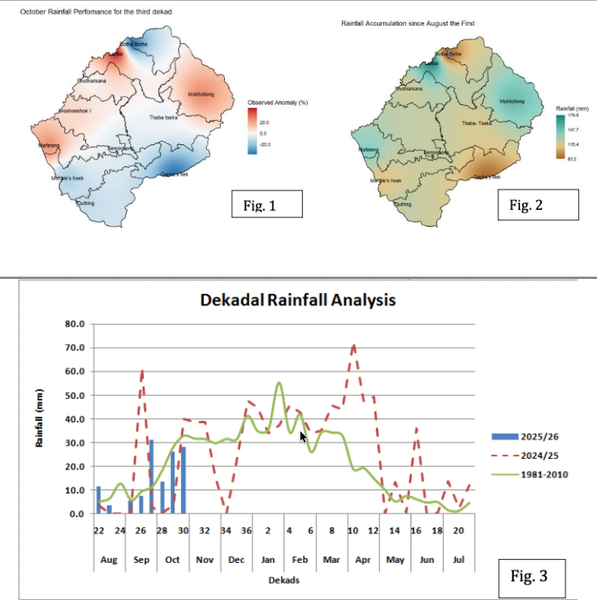
The rainfall performance for third dekad of October 2025 shows a mixed pattern across the country (Fig 1), confirming a distinct spatial difference in recent moisture availability. Areas to the west (Leribe through to Mafeteng) and east (Mokhotlong) display near- normal to above -normal rainfall (Fig 1). Areas in the south (Mohale’s hoek and Quthing and north (Botha-Bothe) show negative (below normal) anomalies shown. This is evident from rainfall accumulation since the start of the season in August shown in Fig.2. For example, in the same period, Mokhotlong recorded 153,3mm against the long term of 120,7mm, while in the north Botha-Bothe observed 80,5mm compared to a normal of 130,5mm.
Although Dekad 3 of October in Fig.3 below shows a slight increase in rainfall compared to the other previous dekads (dekad 1 and 2), it still falls below the long term mean of the dekad.
Temperature
Maximum temperatures observed during the third dekad of October (Fig.4) were above the long-term normals (Fig.5) across the entire country. Fig. 4 shows most of the country experienced maximum temperatures exceeding 26.2⁰C in the southern and western lowlands, only the highest elevated areas specifically Sani-pass, recorded cooler maximum temperatures, falling within the 18.2⁰C to 22.2⁰C range.
Agricultural drought stress index
Water Satisfaction Index (WSI) for pasture tracks overall availability of water for plant growth throughout the seasons, Fig.6 shows a positive trend for the year 2025 up to November 1st. The cumulative WSI has reached a high of over 1000% (1053.78%) by beginning of November. This condition is highly favorable for livestock grazing and suggests a good foundation for crop growth in areas where planting is underway or planned.